
How is milk processed?
The milk that reaches our tables undergoes various processes to ensure it is safe, nutritious and stable. Milk processing ensures that it stays fresh for longer and drastically reduces the number of microorganisms that could cause illness, whilst preserving its key nutrients, calcium, protein and vitamins.
Collection and transport
After milking on the dairy farms, the milk is immediately chilled to around 4 °C to prevent the growth of bacteria. It is then transported in insulated tankers to the dairy, where quality and safety tests are carried out (checking temperature, acidity, fat content and the absence of antibiotic residues).
Clarification and standardisation
Raw milk contains small impurities and solid particles which are removed by centrifugation, in a process known as clarification.
The milk is then standardised, that is, the fat content is adjusted to produce different types of milk:
- whole milk (3.5 %),
- medium-fat (1.5–1.8 %),
- low (less than 0.5 per cent).
This is achieved by separating the fat through centrifugation and mixing the required proportions of cream and skimmed milk.
Pasteurisation

Pasteurisation is the most important step in ensuring food safety.
The milk is heated to 72 °C for 15 seconds and then rapidly cooled.
This process, known as HTST (High Temperature Short Time), eliminates the vast majority of pathogenic bacteria without significantly altering the flavour and with only minor losses of heat-sensitive vitamins.
Other methods include:
- LTLT (Low Temperature Long Time) – 63 °C for 30 minutes, used in small-scale production;
- UHT (Ultra High Temperature) – 135–150 °C for 2–4 seconds, allowing the milk to be stored out of the fridge for several months.
HEAT TREATMENTS
| Type of treatment | Process |
|---|---|
| Pasteurised milk | The most common method. The milk is heated to 72ºC for 15 seconds, then cooled to 4ºC. It should be consumed within 5 days. |
| Sterilised milk | The milk is heated to between 110–130ºC for 10–30 minutes, and then poured into airtight containers. It can be stored for months without refrigeration, but once opened it must be refrigerated and consumed within 5 days. |
| Leite UHT (Ultra-High Temperature) | The milk is heated to at least 135ºC for 1 second and packaged under aseptic conditions. It has a longer shelf life, but the high heat may alter the flavour. |
| Microfiltered milk | It passes through very fine filters that remove bacteria. It can be stored for around 45 days before opening. Once opened, it will keep for 7 days in the fridge. |
During transport and storage, the fat in milk tends to rise to the surface and form a layer of cream.
To prevent this, the milk is homogenised: it passes through valves under high pressure (around 150–250 MPa) which break down the fat globules into tiny particles.
This makes the milk more stable, with a smooth texture and consistent flavour.
Packaging and storage
Following heat treatment and homogenisation, the milk is packaged under hygienic conditions; in the case of UHT milk, under aseptic conditions.
Pasteurized milk must be kept at between 1 and 5 °C, whilst UHT milk can be stored at room temperature until opened.
Other forms of processing
As well as liquid milk, part of the production is processed into other products:
- milk powder, produced mainly by spray drying;
- condensed and evaporated milk, from which some of the water has been removed;
- yoghurts, cheeses and butters, produced by fermentation, coagulation and churning.
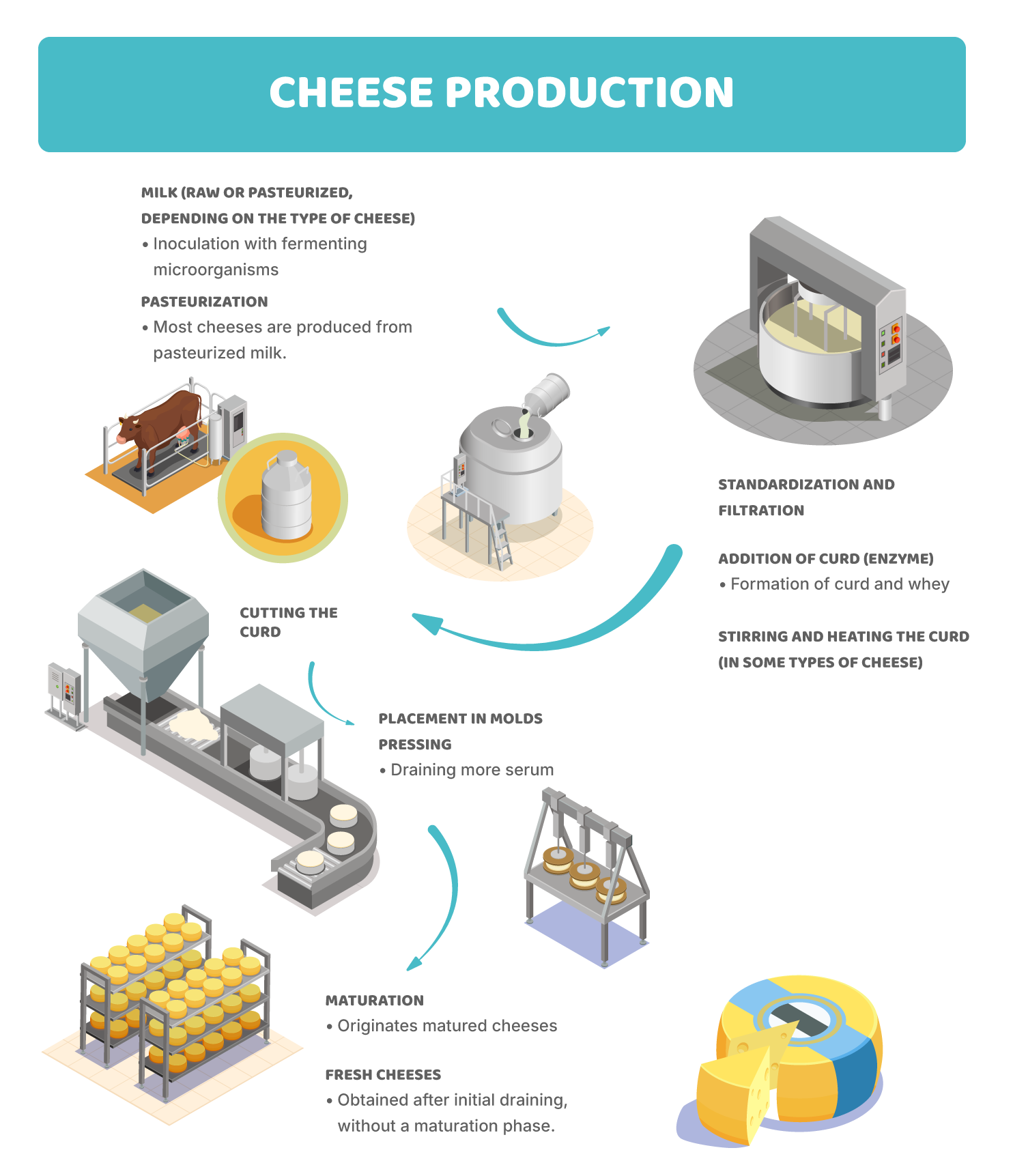
CHEESE-MAKING PROCESS (SECONDARY PROCESSING OF MILK)
| Process | Description |
|---|---|
| Pasteurise the milk | This significantly reduces the microbial load and makes the milk safe |
| Add the lactic acid bacteria culture and leave to ferment | A starter culture is added to the milk. The bacteria convert the lactose in the milk into lactic acid. This helps to acidify the milk and facilitates coagulation. The temperature is maintained at 32–37°C for 20–30 minutes. |
| Add the rennet | Rennet is an enzyme complex that causes milk to curdle. This process takes about 30 minutes. |
| Chop and heat | The curd is cut to separate the whey. The mixture is then heated to release more whey. The temperature and the degree to which the curd is cut vary, depending on whether a soft or hard cheese is desired. |
| Drain the whey | The whey is drained off and the curd begins to form a solid mass. |
| Texturing the curd | The pieces of curd are piled up and turned periodically. This alters the texture and allows the curd to ‘bind together’. The curd is then cut into small pieces. |
| Salgar | Salt is added to enhance the flavour and act as a preservative. |
| Shape | The salted curd is placed in moulds and pressed into blocks to form the cheese. |
| Storing and maturing | The cheese is stored until it reaches the desired maturity. This can take anywhere from a few months to several years, depending on the type of cheese. |
| Pack | The cheese can be cut and packaged in blocks, wax, foil, plastic or vacuum-sealed. |
SUSTAINABILITY IN MILK PROCESSING
Modern dairy plants use technologies that reduce water and energy consumption, reuse by-products (such as whey) and reduce greenhouse gas emissions.
The circular economy is also applied in the dairy sector: organic waste can be used for fertilizers, biogas or animal feed.

A tip for planning your meals
Milk and dairy products are important sources of calcium and protein, but should be consumed in moderation. Choose plain milk, with no added sugar, and prioritise local and sustainably sourced products.
If possible, alternate cow’s milk with plant-based drinks enriched with calcium and vitamin D, to add variety to your diet and help the planet.
FOODWISELAB challenge

To understand how milk is processed into different dairy products, distinguishing between simple processes and more intensive processes, and to reflect on the impact of these processes on the nutritional composition.
FROM MILK TO YOGHURT AND CHEESE: HOW IS MILK PROCESSED?