
FISH AND SEAFOOD
What is
Fish and seafood (molluscs and crustaceans) are sources of high-quality protein and, in the Mediterranean diet, help to balance the meal alongside vegetables, cereals, pulses and olive oil.
As well as protein, they provide iodine, selenium, vitamins D and B12 and, in many species, omega-3 fatty acids (EPA and DHA), which are essential for cardiovascular and brain health.
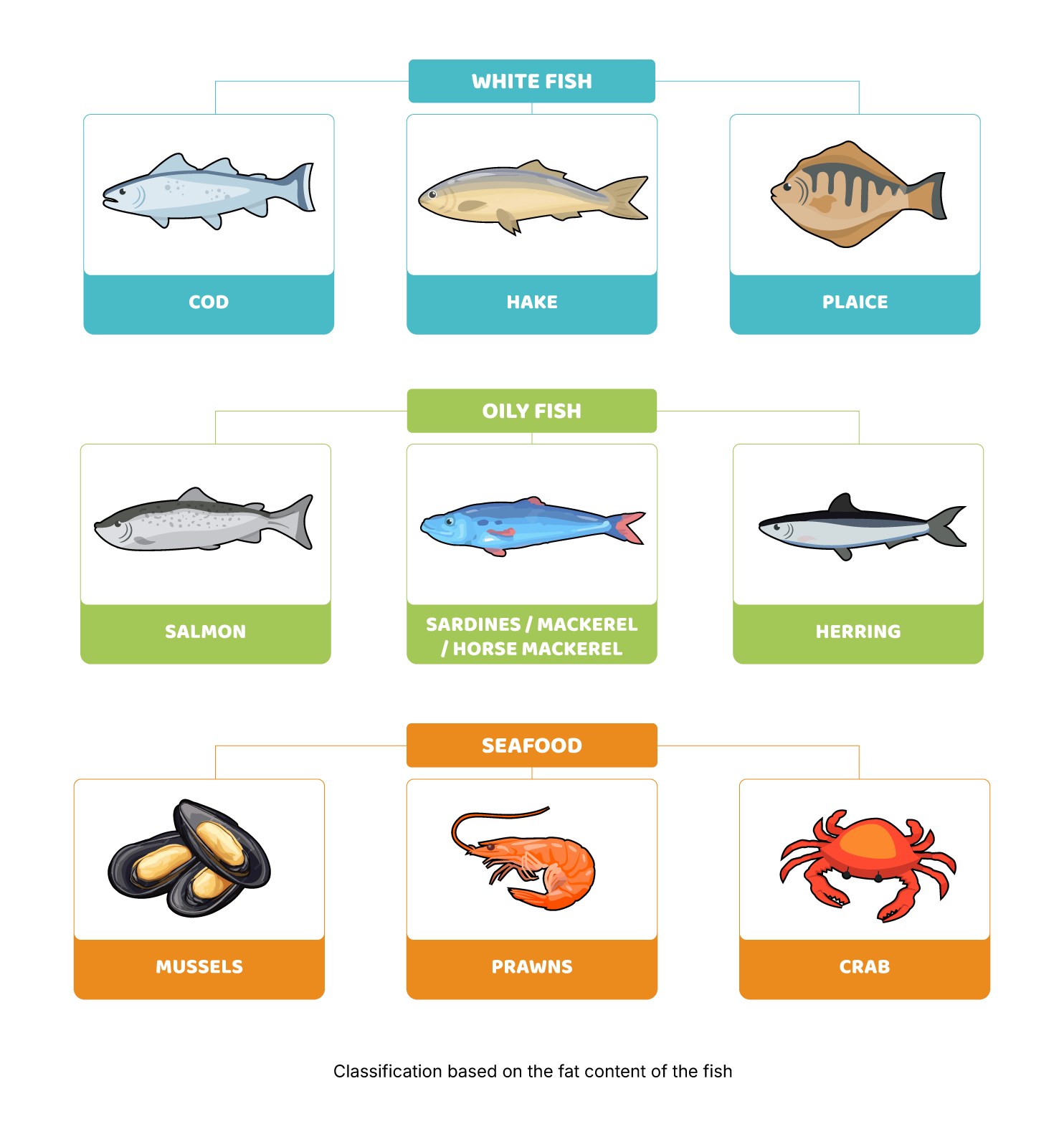
- Fish: aquatic animals with a backbone (e.g. sardines, mackerel, cod, salmon).
- Seafood: molluscs (mussels, clams, octopus) and crustaceans (prawns, crabs).
Why include
It is recommended that you eat fish and seafood twice a week to ensure you get enough omega-3 and essential micronutrients.
Oily fish, such as sardines, mackerel, horse mackerel or salmon, are particularly good for the heart and brain.
Bivalves, such as mussels and clams, have a low environmental footprint and provide calcium, iron, zinc and vitamin B12.
From an environmental perspective, many fish, particularly those caught in small-scale fisheries and bivalves, have a lower environmental impact than land-based meats, making them a sustainable choice within the Mediterranean diet.
| Group | Species (common name — scientific name) | Water (%) | Protein (%) | Fat (%) |
|---|---|---|---|---|
|
Fish |
Bluefin tuna — Thunnus thynnus |
70,7 | 24,2 | 5,1 |
| Peixe | Anchovy (fresh) — Engraulis encrasicolus | 74,4 | 20,6 | 4,9 |
| Fish | Horse mackerel (Mediterranean) — Trachurus spp | 65,5 | 25,1 | 7,5 |
| Fish | Mackerel (Atlantic) — Scomber scombrus | 66,2 | 19,4 | 14,5 |
| Fish | Gilt-head seabream — Sparus aurata | 74,4 | 20,1 | 3,9 |
| Fish | Hake — Merluccius merluccius | 81,6 | 17,5 | 0,9 |
| Fish | Sea Bass — Dicentrarchus labrax | 76,7 | 19,4 | 4,8 |
| Fish | Red mullet — Mullus barbatus | 68,9 | 16 | 12,44 |
| Fish | Sardine — Sardina pilchardus | 65,2 | 18,4 | 16,4 |
| Seafood | Clam — Veneridae spp. | 80,4 | 14,9 | 1 |
| Seafood | Prawn — Penaeidae spp. | 79,2 | 20,3 | 0,5 |
| Seafood | Blue crab — Callinectes sapidus | 81,1 | 18,2 | 0,8 |
| Seafood | Cuttlefish — Sepia officinalis | 81,9 | 16,5 | 0,7 |
| Seafood | Lobster — Homarus spp. | 82,4 | 16,8 | 0,8 |
| Seafood | Squid — Loligo spp. | 79,7 | 15,8 | 1,4 |
| Seafood | Mussel (blue) — Mytilus spp. | 81,9 | 12,1 | 2,3 |
| Seafood | Oyster — Crassostrea spp. | 87,5 | 5,3 | 1,6 |
| Seafood | Squid — Octopus vulgaris | 80,2 | 14,9 | 1,04 |
Notes:
- Whether fish is classified as lean or oily depends on its fat content, which varies by species.
- The fat content of tuna varies depending on the species and cut; standard tinned tuna is generally leaner.
- The fat content of salmon varies depending on its origin and how it is farmed.
- Bivalves generally have a lower environmental impact than large crustaceans.
- Some molluscs, such as oysters, have a lower protein content but are rich in micronutrients.
HOW TO PLAN
Weekly target
2 portions of fish or seafood per week, at least 1 of which should be oily fish (e.g. sardines, mackerel, horse mackerel, salmon).
1 portion ≈ 140 g of cooked fish. Tinned tuna is not a complete substitute for oily fish, but it can count as half a portion of lean fish.
Safety and conservation
- Buy from reliable sources.
- Keep it chilled from the moment you buy it until you get home; store it in the fridge or freeze it if you’re not going to cook it on the same day.
- Keep raw and cooked food separate; defrost in the fridge.
- Cook shellfish thoroughly (the shells should open) and avoid eating raw shellfish.
- Adolescents should avoid eating large fish (e.g. swordfish) frequently, due to their mercury content.
PRACTICAL EXAMPLES FOR PLANNING
- Lunch/dinner:
- Grilled sardines with sweet potatoes and a tomato and cucumber salad.
- Mussel rice with carrots and peppers, finished with coriander and olive oil.
- Oven-baked mackerel fillets with vegetables and couscous.
- ‘Protein-packed’ snack: mixed-grain bread with tuna spread (tuna, natural yoghurt, grated carrot and parsley).
- Zero waste: cook extra fish and use it cold the next day in a Mediterranean salad with black-eyed beans, tomatoes and red onion.

Planning tip
Mark two fish-based meals on your weekly plan (for example, Tuesday and Friday).
Buy oily fish (fresh or frozen) for one meal and tinned fish or shellfish for the other — this way, you can plan your meals in a cost-effective and predictable way.
- Oily fish (sardines, mackerel, horse mackerel) are excellent sources of EPA and DHA.
- Eating fish has proven benefits for cardiovascular health.
- Bivalves (mussels, clams) are rich in iodine and iron and generally have a low environmental impact.
- Regular consumption of fish is associated with better cognitive performance in adolescents.
FOODWISELAB CHALLENGE

To promote meal planning, the use of stock and the consumption of seafood, reducing waste and saving time in the kitchen