
Energy in Ecosystems: food chains, food webs and trophic efficiency
Before we decide what to eat, it is important to understand how food reaches us and how it depends on the ecosystems that produce it. Understanding processes such as photosynthesis, food chains and food webs, or the role of soil in nutrient production helps us realise that our food choices do not happen in isolation: they influence and are influenced by the environment. The following information reinforces this connection, enabling us to plan our meals in a more conscious, sustainable and informed way.
- Food chains, soil networks and human choices
In ecosystems, energy enters through photosynthesis and flows from producers to herbivores and carnivores via food chains and food webs. This network begins right at ground level, where microorganisms, fungi, insects and earthworms form the soil’s food webs. These organisms break down organic matter, recycle nutrients and make them available to plants, which in turn nourish the rest of the ecosystem.
- Three topics pathways stand out within soil networks:
- Root route, ligada às raízes e aos exsudados das plantas.
- Bacterial route, que decompõe rapidamente matéria orgânica fresca.
- Fungal route, mais eficiente a decompor resíduos complexos e a reter nutrientes a longo prazo.
Intensive farming practices, such as excessive tillage and stubble burning, disrupt the fungal network and deplete the soil. In contrast, crop rotation, cover crops and compost maintain the diversity of interactions and make the soil more resilient.
Food chains, food webs and trophic efficiency
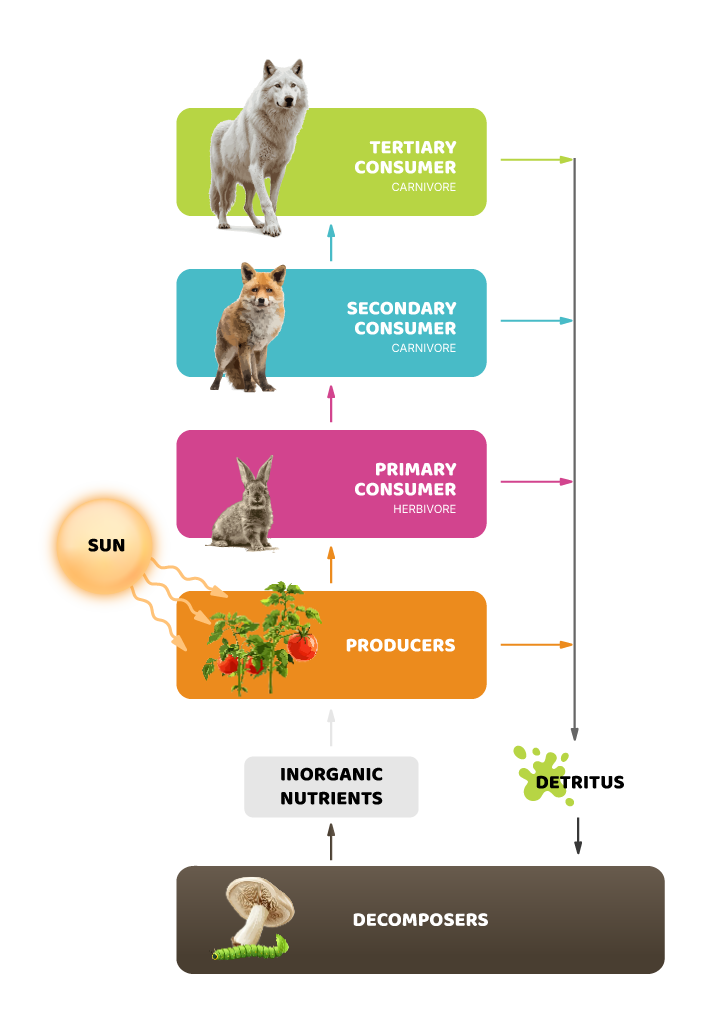
Trophic efficiency and food webs
With each transfer of energy from one trophic level to the next, a large proportion of the energy is lost as heat and through respiration. On average, around 10 per cent is passed on to the next level, which is why food webs are short and there are fewer organisms at the top. In terrestrial ecosystems, 80 to 90 per cent of plant matter does not go to herbivores; instead, it enters the cycle of detritivores and decomposers, which close the cycle and maintain soil fertility. Pyramids of abundance, biomass and energy help to visualise these differences.
Not all environments function in the same way; in aquatic systems, productivity depends heavily on light and nutrients and can be concentrated in coastal upwelling zones; conversely, an excess of nutrients can cause eutrophication and lead to the collapse of food webs.
Aquatic food webs and human impacts
Marine and freshwater food webs are sensitive to overfishing, the loss of predators, pollution and climate change. These factors disrupt food webs and reduce food security. Informed consumer choices, such as choosing sustainably sourced fish and protecting coastal habitats, help to maintain stable food webs.
Invasive species and web structures
Some invasive species simplify web structures, reduce the number of pollinators and compete with plants that are useful to agriculture. Controlling invasive species and planting native species protects local production and the biodiversity that sustains our food supply.
DID YOU KNOW THAT…

In many terrestrial ecosystems, most of the energy produced by plants does not go to herbivores; instead, it is broken down by detritivores and soil microbes, which return nutrients to the roots.
Certain pollutants can become more concentrated as they move up the food chain – a phenomenon known as biomagnification – which is yet another reason to reduce pollution and adopt responsible farming practices.

Plan your meals, conserve the ecosystem’s energy
When you choose more plant-based foods, you are using fewer ‘energy steps’ in the food chain, making the system more efficient and conserving the ecosystem’s resources.
A plant-based diet in everyday life – comprising vegetables, fruit, whole grains and pulses as a source of protein – requires fewer ‘energy steps’ than foods at the top of the food chain.
Fish and meat in moderate portions, choosing sustainably sourced products and species that are not overfished.
It promotes food from farming systems that look after the soil, through composting, cover crops and crop rotation; the ‘invisible work’ of decomposers maintains the fertility that sustains the food on your plate.
Compare two menus: one with a higher proportion of plant-based foods and the other richer in animal products. Which one uses fewer ecosystem resources, and why?
FOODWISELAB CHALLENGE

To understand how different dietary choices influence the use of energy and natural resources, by comparing food webs at different positions in the food chain.
FOOD WEBS AND ECOSYSTEM ENERGY